
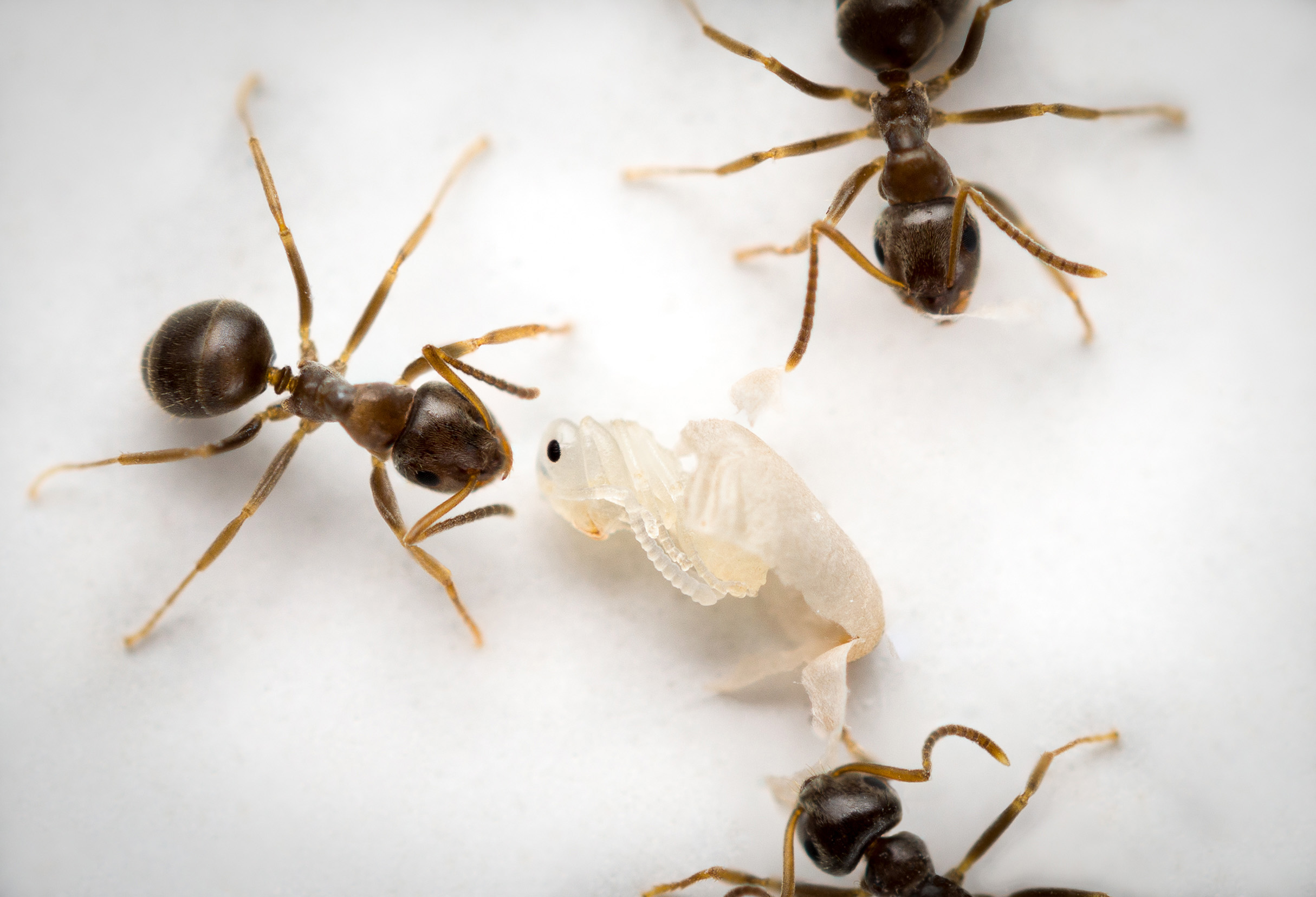
Dawson EH, Hoenigsberger M, Kampleitner N, Grasse AV, Lindorfer L, Robb J, Beikzadeh F, Strahodinsky F, Leitner H, Rajendran H, Schmitt T, Cremer S
Nature Communications 16, 10511 (2025)
doi: 10.1038/s41467-025-66175-z
Abstract
Sick individuals often conceal their disease status to group members, thereby
preventing social exclusion or aggression. Here we show by behavioural,
chemical, immunological and infection load analyses that sick ant pupae
instead actively emit a chemical signal that in itself is sufficient to trigger their
own destruction by colony members. In our experiments, this altruistic
disease-signalling was performed only by worker but not queen pupae. The
lack of signalling by queen pupae did not constitute cheating behaviour, but
reflected their superior immune capabilities. Worker pupae suffered from
extensive pathogen replication whereas queen pupae were able to restrain
their infection. Our data suggest the evolution of a finely-tuned signalling
system in which it is not the induction of an individual’s immune response, but
rather its failure to overcome the infection, that triggers pupal signalling for
sacrifice. This demonstrates a balanced interplay between individual and social
immunity that efficiently achieves whole-colony health.